
Why Most Men Start at the Wrong End
When men finally decide “that’s it, I’m getting healthy,” they almost never start with daily movement and easy cardio. They start with: a strict diet, a savage HIIT plan, or a heavy strength program.
There’s a reason the media is full of “10‑minute HIIT fat‑burners” and “drop a stone in 4 weeks” diets: they’re easy to sell and they sound exciting. “Do 10 x 20‑second intervals” is a much sexier headline than “do 60 minutes of easy cardio 5–6 days a week for the rest of your life.”
The problem is that those things are built to sell speed, not to build your healthspan – the years you’re alive, active, and not falling apart. If your real goals are:
- Get your weight under control and stop the middle‑age spread
- Have more energy and a clearer mind
- Sort your health out before something serious happens
- Feel strong again and get your physical edge back
- Feel like yourself in your body again and get your pride back
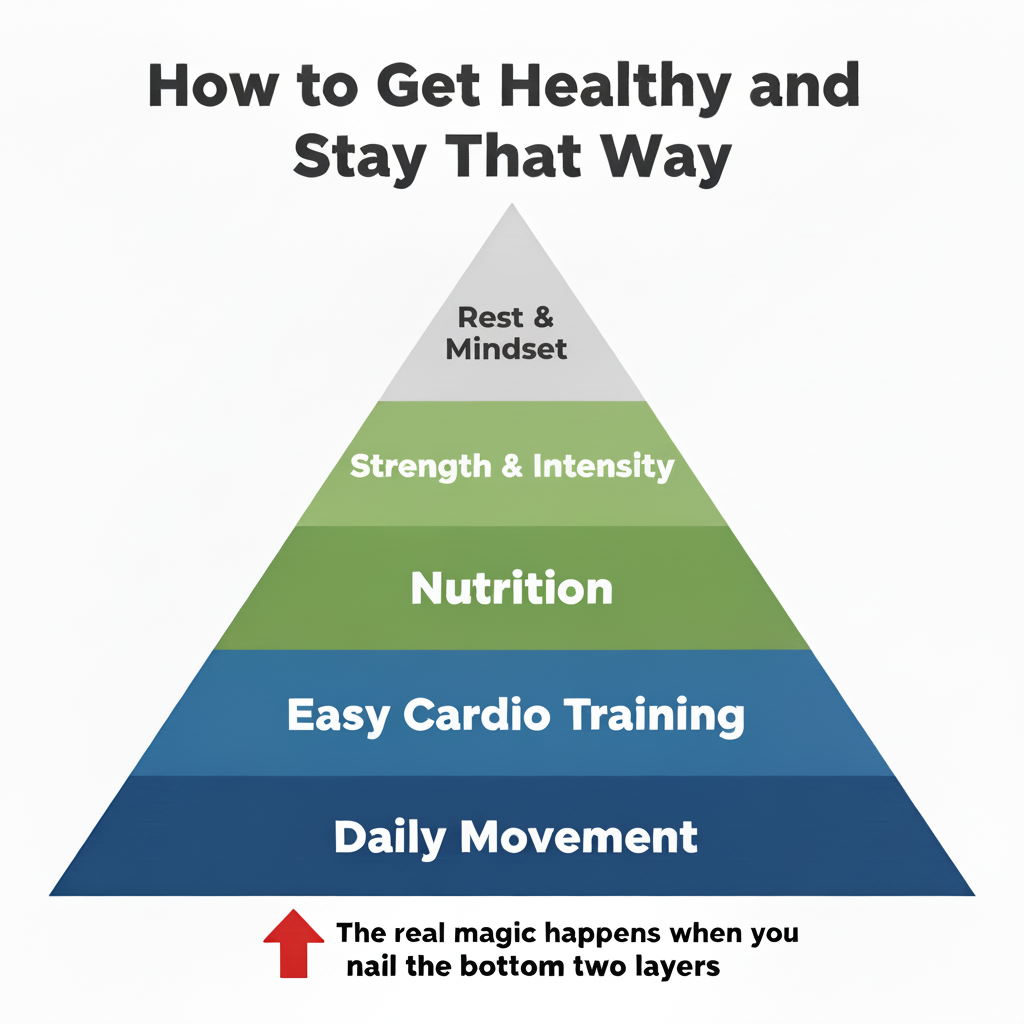
…then you don’t need the most dramatic plan. You need the most repeatable one. That’s why this pyramid starts at the bottom: you nail the base first, then layer everything else on top.
The Pyramid: Start at the Bottom, Stay There for Life
Your “How to Get Healthy and Stay That Way” pyramid has five layers:
- Daily Movement
- Easy Cardio Training
- Nutrition
- Strength & Intensity
- Rest & Mindset
The key message: the bottom two layers are where the magic happens – especially for men over 40 who’ve let things slide. Everything above them works better because those foundations are solid, not instead of them.
Layer 1: Daily Movement – Stop Being a Sedentary Bloke
Daily movement is the stuff you do in normal clothes: walking to the shops, taking stairs, housework, gardening, pottering about. It sounds basic, but the jump from “mostly sitting” to “moving regularly” is where a huge chunk of the health benefit actually comes from.
For decades we’ve known this. In the classic London bus study, drivers who sat all day had much higher rates of heart disease and early death than conductors who spent their shifts walking the stairs and collecting fares. More recent research shows prolonged sitting is linked to higher risks of heart disease, diabetes, cancer and early death – and that simply replacing small chunks of sitting time with light movement can cut those risks significantly.
So in this layer, the goal is to consciously dial up movement in your normal life:
- If you usually sit on calls, stand. If you usually stand, walk slowly or add gentle calf raises or bodyweight squats.
- If you’re desk‑bound, set a timer and get up every hour for 3–5 minutes: walk to the other end of the office, down and up a flight of stairs, then back to your desk.
- Park a bit further away, take stairs instead of lifts, and treat every chance to move as part of your training, not an optional extra.
This is why I ask you to do it: going from “sit all day” to “regularly on your feet and moving” is the single biggest step you can take to raise your baseline health and make the rest of the pyramid actually work.
Layer 2: Easy Cardio Training – Build the Engine, Burn Fat
This is where you put on exercise or training kit and treat it as deliberate exercise: fast walking, easy cycling or light jogging where you can still talk in full sentences.
At this easy effort, your body can comfortably use fat as its main fuel, and with regular training the proportion of fat you burn at a given pace goes up over time. Go too hard and your body switches over to mostly carbs; stress hormones go up and the “fat‑burning workout” you thought you were doing turns into something very different.
The only other way to burn a lot of fat is to eat less – often a lot less – which usually means low energy, strong cravings and poor recovery. You might lose weight for a bit, but you feel rough, your training suffers, and most men can’t hold it. Easy cardio does the opposite: it lets you burn fat, lower stress and blood pressure, and build fitness at the same time, which makes everything else in your plan easier instead of harder.
In practice, that means you get:
- Steady fat loss without feeling wrecked.
- Lower stress and blood pressure, better mood and focus.
- Better recovery so strength and harder work later actually stick.
- And crucially: once you’ve spent 30–60 minutes building your engine, you’re less likely to sabotage it with junk food and booze – the habit starts to protect itself.
Why You Don’t Start with Diet
“Right, I’ll sort my diet out” is a classic starting point. The appeal:
- Feels decisive and serious
- Promises quick weight loss
- You don’t have to leave the house
The problems if you haven’t built the base first:
- When you’re unfit and exhausted, willpower is low; restrictive diets are hard to sustain.
- If you’re still sedentary, you’re trying to out‑think a body that wants quick energy and comfort food.
- You miss the powerful feedback loop of “I trained today, I don’t want to undo it.”
Diet absolutely matters – it’s in the middle of the pyramid for a reason. But it works best when it’s supporting an engine that already exists, not replacing it.
Why You Don’t Start with Strength or High‑Intensity Work
Jumping straight back into heavy lifting or brutal intervals is tempting because:
- It feels “serious” and masculine
- You used to train like that in your 20s
- You want fast results
The problems for a man over 40 who’s let things slide:
- Joints, tendons and back are not ready for sudden high loads; injury risk is higher.
- Hard sessions spike stress hormones and appetite when your recovery is poor.
- When every workout feels like a fight, you won’t stay consistent.
Strength and intensity absolutely have a place – they’re how you rebuild muscle, resilience and athleticism. But they belong after the base is in place, not as the first brick.
How the Middle and Top Layers Fit In
Once Daily Movement and Easy Cardio Training are established, the rest of the pyramid clicks into place.
Nutrition – Fuel the Engine You’ve Built
With a consistent cardio base:
- Your appetite signals are more stable and you tolerate calories better.
- Simple changes (more whole food, enough protein, less ultra‑processed stuff and alcohol) move the needle quickly.
- Weight comes off without your life revolving around a diet plan.
Strength & Intensity – Look, Feel and Perform Better
Now your tissues, heart and lungs can handle load, strength and intensity give you:
- More muscle and strength for real‑life tasks
- Better shape in and out of clothes
- A higher ceiling so daily life feels easier, not harder
Rest & Mindset – Make It Stick
Sleep, stress and mindset are what turn a good 4–8 week run into your new normal, not just another phase. The good news is that by the time you’ve nailed Daily Movement, Easy Cardio and started tidying up nutrition, a lot of this is already moving in the right direction: regular aerobic exercise and walking are consistently linked with better sleep quality, lower anxiety and fewer depressive symptoms, even at moderate and low intensities.
For most men, that means:
- Sleep often improves naturally once you’re moving more and training your engine – you’re physically tired in a good way, so dropping off and staying asleep gets easier.
- Physical stress is better managed, and some mental stress eases because you’ve finally tackled one major problem (your health), which makes you feel more in control and better able to deal with the rest.
- Mindset shifts from “I’m trying another plan” to “I’m a bloke who trains every day and eats healthy”, which makes relapse less likely and stops you starting again from zero every January.
This layer is less about fancy techniques and more about protecting the habits you’ve already built so they keep paying you back for years.
Putting It into Practice: One Layer at a Time
For a man over 40 who’s let things slide, a simple sequence might look like this.
Week 1: Daily Movement only
- Consciously dial up movement in your normal life: steps, stairs, walking to the shops, standing or walking on calls.
- Aim for a clear step target or simple “x minutes walking” every day.
Weeks 2–4: Add Easy Cardio Training
- 3–5 sessions a week, 30–60 minutes, all at an easy, sustainable effort where you can still talk.
Weeks 4–6: Build the Easy Cardio Habit
- Increase to 5–7 sessions a week of 30–90 minutes, still easy and repeatable.
Weeks 6–10: Layer in Nutrition
- Keep the daily movement and easy cardio non‑negotiable.
- By this stage you’ll be lighter on your feet, breathing easier and seeing the first changes in energy, mood and waistline – which makes you ready to tackle food, rather than forcing it from day one.
- Tidy up food: more whole foods, less processed junk, and get conscious about alcohol intake.
After 10+ weeks: Strength & Intensity
- Add 2 short strength sessions a week.
- Sprinkle in the odd harder cardio session on top of your base, not instead of it.
Ongoing: Rest & Mindset
- Protect sleep, manage stress, and keep reminding yourself: the bottom of the pyramid is non‑negotiable.
You’re not trying to fix everything at once. You’re building from the bottom up, in a way your 40‑plus body and life can actually handle.